
Revocable Trust Attorney in Smithtown & Syosset, NY
Keep Control, Avoid Probate, and Plan for Incapacity
Reviewed by Cheryl L. Fratello, Esq. · Last updated October 26, 2026
A revocable living trust lets you keep full control of your home and savings during your lifetime, then pass them to your family without probate. It also names who manages your assets if you become incapacitated. Fratello Law drafts and funds revocable trusts for Long Island families from our offices in Smithtown (Suffolk County) and Syosset (Nassau County).
Schedule a consultation: Smithtown (631) 406-5580 · Syosset (516) 321-4010
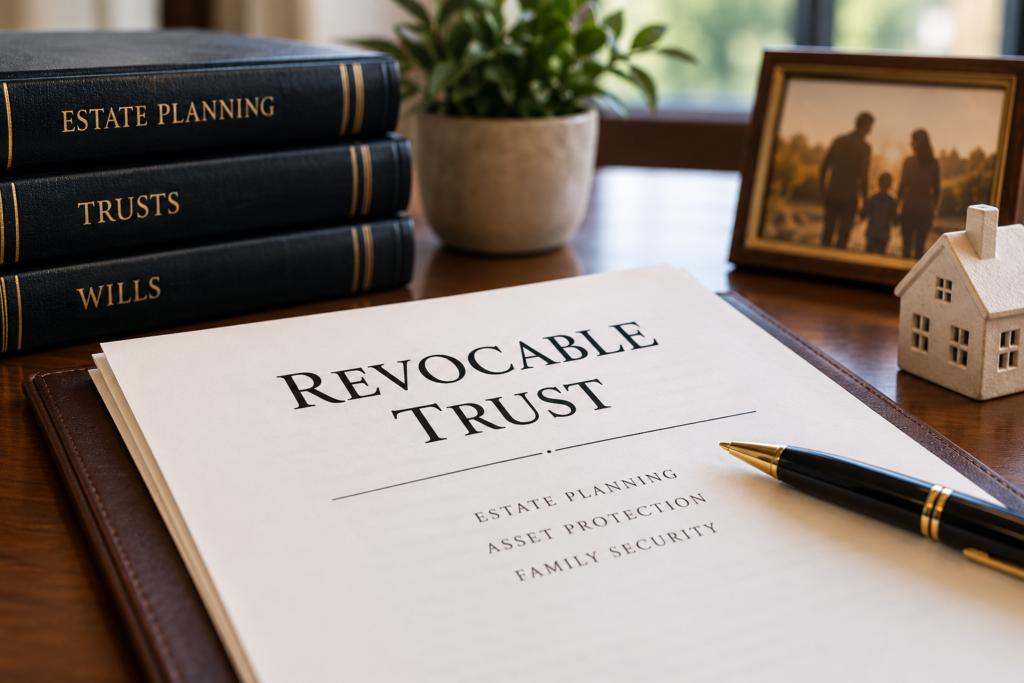
- REVOCABLE TRUST QUESTIONS ANSWERED -
Does a revocable trust avoid probate in New York?
Yes, for every asset the trust actually owns at your death. Your successor trustee transfers those assets to your beneficiaries privately, without a petition to the Suffolk County Surrogate’s Court in Riverhead or the Nassau County Surrogate’s Court in Mineola. Assets left in your individual name still go through probate. That is why funding the trust, meaning retitling your house and accounts into it, matters as much as signing it. Retirement accounts and life insurance usually pass by beneficiary designation instead.
Does a revocable trust protect my assets from nursing home costs?
No. Because you can take the assets back at any time, Medicaid counts everything in a revocable trust as your own resource under federal law (42 U.S.C. § 1396p(d)(3)(A)). A revocable trust also offers no protection from your creditors. If your goal is to protect a home or savings from long-term care costs, that calls for an irrevocable Medicaid Asset Protection Trust (MAPT), which is subject to New York’s five-year look-back for nursing home Medicaid. Many families use both trusts for different assets. See our Medicaid planning page.
Do I still need a will if I have a revocable trust?
Yes. Every revocable trust plan should include a pour-over will. It catches any asset you forgot to transfer, or acquired later, and directs it into your trust. It is also where you nominate a guardian for minor children, which a trust cannot do. A pour-over will may still need to be probated if assets are left outside the trust, so the goal is to keep that will as a safety net rather than the main plan.
Can I be the trustee of my own revocable trust?
Yes, and most people who create one do. You keep full control: you buy, sell, refinance and spend exactly as you do now, and you keep using your own Social Security number for taxes. Married couples often serve as co-trustees. You name one or more successor trustees, such as an adult child or a trusted relative, who step in only if you become incapacitated or after you pass away.
Can I change or cancel my revocable trust later?
Yes, as long as the trust document says it is revocable. Under New York law, a lifetime trust is irrevocable unless it expressly states otherwise (EPTL 7-1.16), so the wording matters. An amendment or revocation must be in writing, signed, and acknowledged or witnessed the same way as the original trust (EPTL 7-1.17). We recommend reviewing your trust every three to five years and after a marriage, divorce, death, birth or move.
What happens to my revocable trust if I become incapacitated?
Your successor trustee takes over managing the trust assets for your benefit, following the incapacity standard written into your trust. This usually avoids an Article 81 guardianship proceeding for those assets. Your family can pay your bills, manage your home and handle investments without going to court. You still need a durable power of attorney and health care proxy for assets and decisions outside the trust, such as retirement accounts, tax filings and medical care.
Will putting my house in a revocable trust affect my taxes?
Usually not. A revocable trust is ignored for income tax purposes while you are alive, so you keep the federal home sale exclusion. Your heirs generally receive a stepped-up basis at your death. A deed into your own revocable trust is typically exempt from New York real estate transfer tax because no money changes hands, although transfer forms are still filed. STAR and senior exemptions generally continue, but check your town assessor’s filing requirements after the deed is recorded.
Does a revocable trust reduce New York estate tax?
Not by itself. Trust assets are still part of your taxable estate. A revocable trust can, however, contain credit shelter trust provisions that matter for married couples, because New York has no portability. For 2026, the New York basic exclusion amount is $7,350,000 (NYS Department of Taxation and Finance), and estates more than 5% above it lose the exclusion entirely. The 2026 federal exemption is $15,000,000 per person. Couples near those figures should plan the trust around them. See estate tax planning.
HOW DOES A REVOCABLE LIVING TRUST WORK IN NEW YORK?
A revocable living trust is a written agreement in which you transfer your assets to yourself as trustee, for your own benefit during your lifetime. When you pass away, the trust becomes irrevocable and your successor trustee distributes or holds the assets under the instructions you wrote.
Every revocable trust has the same four roles:
- Grantor: you, the person who creates and funds the trust.
- Trustee: the person who manages the assets. Usually you, or you and your spouse.
- Successor trustee: the person who takes over at your incapacity or death.
- Beneficiaries: you during your lifetime, then your spouse, children or others you name.
New York has formal signing rules. Under EPTL 7-1.17, the trust must be in writing, signed by you and, unless you are the sole trustee, by at least one trustee. It must be acknowledged before a notary or signed in front of two witnesses. A trust bought online or signed at a kitchen table without those formalities may not hold up.
WHY IS FUNDING THE TRUST SO IMPORTANT?
A New York trust only controls the assets actually transferred into it. EPTL 7-1.18 says a trust is valid only to the extent assets have been transferred to it. Listing an asset on a schedule is not enough.
For example, consider a Commack widow who signed a trust years ago but never recorded a new deed. Her house stayed in her own name. At her death, her daughter would still need to probate the will in Riverhead to sell the house. That is exactly what the trust was meant to avoid.
Funding a revocable trust usually means:
- Your home: a new deed from you to yourself as trustee, recorded with the Suffolk or Nassau County Clerk.
- Bank and brokerage accounts: retitled into the trust’s name, or set to pass to the trust at death.
- Out-of-state real estate: a deed recorded in that state, so your family avoids a second probate there.
- Business interests: an assignment of LLC membership or corporate shares, reviewed against your operating agreement.
- Retirement accounts and annuities: usually left in your name, with beneficiaries coordinated with the trust for tax reasons.
Fratello Law prepares and records the deed for your Long Island home as part of the trust engagement. Our real estate practice handles the transfer forms. We give you written funding instructions for each account.

REVOCABLE TRUST OR WILL: WHICH IS RIGHT FOR YOUR FAMILY?
A will is a set of instructions for the Surrogate’s Court. A revocable trust is a plan your family can carry out without the court. Both are valid choices, and the right one depends on your assets and your family.
| Will | Revocable Trust | |
|---|---|---|
| Probate required | Yes, for assets in your name | No, for funded assets |
| Public record | Yes, once filed with the court | No, stays private |
| Manages assets during incapacity | No | Yes |
| Court filing fee | Up to $1,250 (SCPA 2402) | None for trust assets |
| Upfront work | Lower | Higher, because assets must be retitled |
| Medicaid protection | No | No |
Our main trusts page compares every type of trust we prepare.
WHO BENEFITS MOST FROM A REVOCABLE TRUST?
A revocable trust is most useful when probate would be slow, costly or public. It is a strong fit if you:
- Own property in another state. A Hauppauge couple with a Florida condo can avoid a second probate proceeding in Florida.
- Want privacy. A probated will becomes a public court file. A trust does not.
- Have a blended family. A trust can provide for a spouse for life and then pass assets to children from a prior marriage.
- Have a child who is young, struggles with money or receives benefits. The trust can hold an inheritance over time. A child with a disability may need a supplemental needs trust.
- Expect a family member to contest. A trust is generally harder to challenge than a will offered for probate.
- Want a plan for incapacity. Your successor trustee steps in without a court proceeding. See disability planning.
A revocable trust is not the right tool for everything. If nursing home costs are your main concern, read about asset protection and long-term care planning. Those goals use irrevocable trusts.
WHAT DOES THE REVOCABLE TRUST PROCESS LOOK LIKE AT FRATELLO LAW?
- Consultation. We review your family, your assets and your goals at our Smithtown or Syosset office.
- Design. We recommend trustees, distribution terms and tax provisions, and explain how the trust fits with your will, power of attorney and health care proxy.
- Drafting and review. You receive drafts to read, and we walk through every section before signing.
- Signing. You sign with a notary and witnesses at our office, meeting New York’s formal requirements.
- Funding. We prepare and record the deed to your home and give you written instructions for each account.
- Ongoing review. We update your trust as the law, your assets and your family change.
WHY LONG ISLAND FAMILIES CHOOSE FRATELLO LAW
- A combined estate planning and elder law practice. We plan your revocable trust with Medicaid and long-term care in mind, so one trust doesn’t undo another.
- Local knowledge. We file regularly with the Suffolk and Nassau Surrogate’s Courts and County Clerks.
- Experience. Cheryl L. Fratello has practiced law for over 20 years and founded Fratello Law in 2012. Meet Rachel S. Katz, Esq. and the rest of our team.
- Funding handled in-house. Deeds and transfer forms are prepared by our own office, not left to you.
- Two convenient offices. Smithtown for Suffolk County families and Syosset for Nassau County families.
Read what clients say on our testimonials page.
WHAT OUR CLIENTS SAY
“
Rachel was extremely knowledgeable and professional. She thoroughly explained and described all relevant and pertinent factors to enhance and maximize our estate planning process.
— M.S., Google review
“
Cheryl, as well as her staff, are extremely accommodating and made every step of this process easy and understandable for my parents which I truly appreciate. Very professional, detailed as well as considerate which people do need in dealing with this part of their life.
— John N., Google review
“
I would highly recommend Fratello law. Cheryl Fratello did my estate planning and put my mind at ease. They are kind, caring and professional.
— J.W., Google review
Prior results do not guarantee a similar outcome.
SCHEDULE A REVOCABLE TRUST CONSULTATION
A revocable trust works best when it is set up and funded while you are healthy. Call the office closest to you, or contact us online.
Smithtown: (631) 406-5580 · Syosset: (516) 321-4010
Office hours are Monday through Friday, 9 a.m. to 5 p.m. After-hours appointments are available by special request.
OUR OFFICES AND COMMUNITIES WE SERVE
Smithtown Office (Suffolk County)
Fratello Law, P.C.
26 Landing Avenue, Smithtown, New York 11787
(631) 406-5580
Serving Smithtown, Hauppauge, Commack, Nesconset, Kings Park, St. James, Stony Brook, Huntington, Centereach, Lake Grove, Port Jefferson and surrounding Suffolk County communities. Smithtown office details.
Suffolk County Surrogate’s Court: 320 Center Drive, Riverhead, NY 11901, (631) 852-1745. Court website.
Syosset Office (Nassau County)
Fratello Law, P.C.
485 Underhill Boulevard, Suite 102, Syosset, New York 11791
(516) 321-4010
Serving Syosset, Woodbury, Jericho, Plainview, Hicksville, Old Westbury, Oyster Bay, Manhasset, Great Neck, Glen Cove and surrounding Nassau County communities. Syosset office details.
Nassau County Surrogate’s Court: 262 Old Country Road, Mineola, NY 11501. Court website.
Related pages: Estate Planning · Trusts · Wills · Power of Attorney · Estate Tax · Estate Administration · Medicaid Planning · Special Needs Planning
We provide trust planning services to families in the following areas
- Babylon
- Brentwood
- Brookhaven
- Centereach
- Central Islip
- Cold Spring Harbor
- Commack
- Coram
- Deer Park
- East Hampton
- Hauppauge
- Holbrook
- Huntington
- Huntington Station
- Islandia
- Islip
- Kings Park
- Lake Grove
- Lake Ronkonkoma
- Lindenhurst
- Lloyd Harbor
- Melville
- Nesconset
- Riverhead
- Ronkonkoma
- Shirley
- Smithtown
- South Huntington
- Southampton
- Stony Brook
- West Babylon
- West Hills
- Baldwin
- Bethpage
- Brookville
- Centre Island
- Cove Neck
- East Meadow
- East Norwich
- Elmont
- Franklin Square
- Freeport
- Glen Head
- Great Neck Gardens
- Hempstead
- Hicksville
- Jericho
- Laurel Hollow
- Levittown
- Locust Valley
- Long Beach
- Matinecock
- Mill Neck
- Muttontown
- New Cassel
- North Hempstead
- Old Bethpage
- Old Brookville
- Old Westbury
- Oyster Bay
- Oyster Bay Cove
- Plainview
- Uniondale
- Upper Brookville
- Valley Stream
- Woodbury